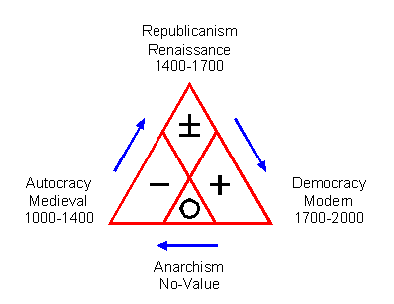
Every political system is an ideal one, for everyone fought against was once fought for as an ideal government, best for freedom, but which kind of freedom -- spiritual, rational or sensual or even no-valued? Autocracy is the ideal for restoring social unity and spiritual freedom after a Dark Age of No-values. But it necessary suppresses free rationality and sensuality. This causes the rationalist to fight for republicanism as the ideal for rational freedom and harmony of diversity. But this necessitates suppression of spiritual and sensual extremes to gain moderation. The repressed sensual then fight for Democracy as an ideal that permits most sensual freedom and individual diversity. This necessitates spiritual inhibitions and rational moderation, as well as extreme sensualists. The extreme sensualists fight for their ideal of uninhibited and unrestricted -freedom,. This makes enemies of all who fear in the resultant Dark Age, whether dominantly spiritual, rational or sensual. These accept autocracy as the ideal to replace the hell of anarchy. Values of these ideal forms of government and societies are trinitized below:
    -                     ±                      +                      0
AUTOCRACY   ———————>   REPUBLIC   ———————>   DEMOCRACY   — — — —>   ANARCHISM
King                   Council               People                 Mob
Nobleman               Gentleman             Common man             Mob leader
Noble knight           Rich merchant         Popular demagog        Strong man
Aristocracy            Bourgeoisie           Proletariat            Commune
High Class             Middle Class          Low Class              No class
Best rule              Average rule          Worst rule             Might rules
Right wing             Middle road           Left wing              Conflicting Extremes
Reactionaries          Moderates             Radicals               Extremists
    -                     ±                      +                      0
AUTOCRACY   ———————>   REPUBLIC   ———————>   DEMOCRACY   — — — —>   ANARCHISM
Authority              Reason                Experience             No reason
Rigid rule             Flexible rule         Loose rule             No rule
Obey authority         Respect authority     Reject authority       No authority
Duty to do             Privilege to do       Right to do            Do nothing
Disciplined            Self-disciplined      Undisciplined          No control
Tyranny                Justice               Freedom                No justice
Law of God             Law of Nature         Law of Man             No law
Spiritual value        Rational value        Sensual value          No value
    -                     ±                      +                      0
AUTOCRACY   ———————>   REPUBLIC   ———————>   DEMOCRACY   — — — —>   ANARCHISM
Unity                  Unity of diversity    Diversity              Divisiveness
Catholicism            Humanism              Individualism          Equality
Religious              Political             Social                 Self-survival
Security               Leisure               Pleasure               Apathy
Feudalism              Mercantilism          Socialism              Commune